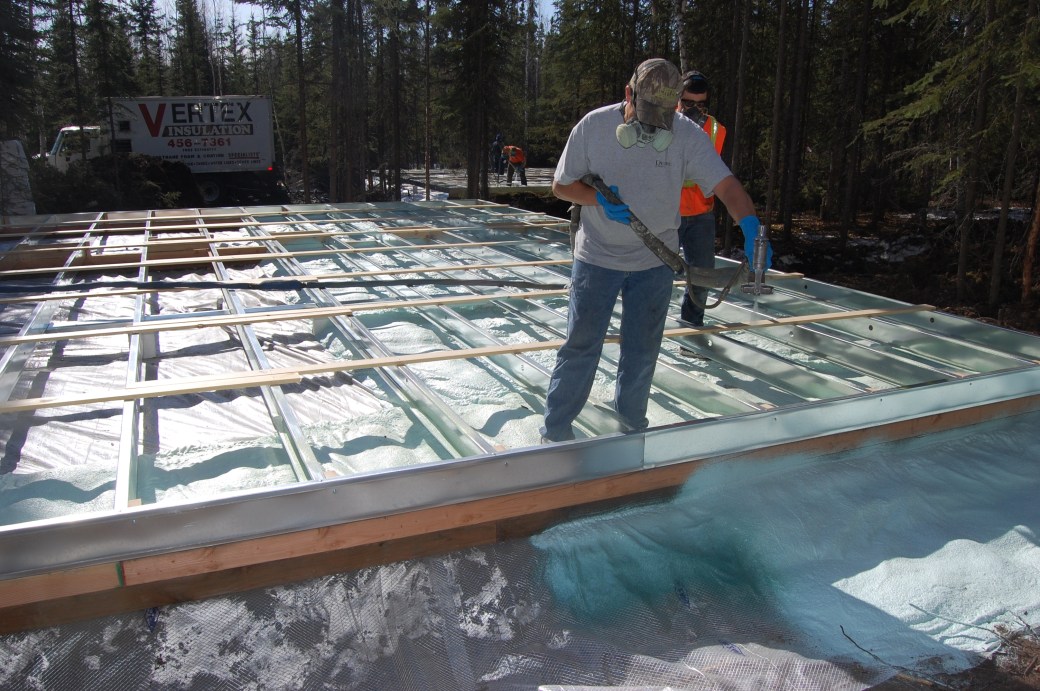
Permafrost: Engineering for Change

foam_mat

Credit: Cold Climate Housing Research Center

I’m a relative newcomer to Fairbanks. I’ve lived in the ‘Golden Heart City’ almost 35 years. But that is a drop in the bucket for those who were born or raised here. And when you consider Alaska Natives can mark their time in millennia, I’ll always be a cheechako. But whether you’ve lived here a season or a lifetime, almost everyone agrees we are in a time of transition. Wet, icy conditions now seem to plague Fairbanks each fall, turning our roads into those found in Anchorage or Seward, not the Interior.  News reports offer a drumbeat of accounts about degrading infrastructures and coastal communities imperiled by rising water levels.

This episode I talk to the engineers who are tackling these issues.  Later in the program, I’ll talk with Doug Goering, who recently received an award from the American Society of Civil Engineers for his work in the north. And the Cold Climate House Research Center is offering a class on building on permafrost.

But I begin with my conversation with Paul Perreault.  Paul and I both used to work for the Catholic Diocese of Fairbanks. He was the diocese’s engineer, pilot and a deacon. As engineer, he was responsible for building and maintaining over 50 structures in almost as many communities scattered across the northern half of the state. What impressed me was how he married his considerable engineering skills with an ability to listen to and respect the knowledge and experience of the villagers with whom he worked.  Paul eventually left the diocese to get his doctorate in engineering from the University of Alaska Fairbanks. As you’ll hear, he wanted to respond to the conditions he was witnessing.

Glen Shaw: Provisional Knowledge

ShawGlenn_AtmosphericSciences

This episode we look at suspect science and fake news. President Donald Trump as well as some of his cabinet members have expressed skepticism about climate change and its research. The administration’s proposed federal budget reflects deep cuts in science funding. But the stakes are incredibly high, and the facts can’t be dismissed. That’s what University of Alaska Fairbanks professor emeritus Glen Shaw recently told me. Shaw is best known for his work on Arctic haze. But for years he’s also been a contrarian about alarmist headlines on global warming.  When I caught up with him when he was last in Fairbanks, I discovered he’s tempered his skepticism. In fact, he’s deeply concerned about the earth’s climate, to say nothing about the current political climate.

Later in the show UAF philosophy and biology professor Eduardo Wilner explains why human reason offers the best hope for solving problems. And award-winning journalist and UAF Journalism professor Brian O’Donoghue suggests some tips for dealing with fake news.

Also, on the show is artist and art historian Kesler Woodward. He explains representational artists try to fool viewers all the time. And Chris Lott brings us another installment of katexic clippings.

Evon Peter: Changing the Statistics

WBA_Share1

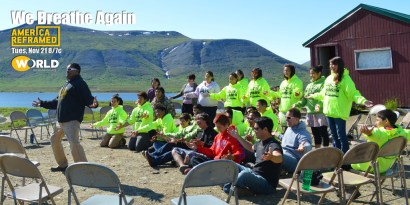
Last month, a documentary that examines the impact of suicide on the lives of four Alaskans premiered on PBS World Channel’s America ReFramed. Early in We Breathe Again, filmmakers share the distressing statistic that suicide is a leading cause of death for Alaska Natives between the ages of 15 and 24. My guest this episode is Evon Peter. He not only was a producer for the documentary, but has been a Gwich’in tribal chief and educator. Currently, he serves as Vice Chancellor for rural, community and Native education at the University of Alaska Fairbanks. He knows firsthand the challenges of growing up in rural Alaska.

Also on the show, this weekend the Fairbanks Symphony Orchestra will perform Prokofiev’s Romeo and Juliet Suite #2. Most people know, suicide figures in Shakespeare’s play. As you’ll hear in the next several interviews, the play’s tragic ending often prompted adapters and producers to change the work into a comedy. I asked Fairbanks Symphony Orchestra’s principle bassoonist and marketing director George Rydlinski to lead us through Prokofiev’s treatment of Romeo and Juliet and how other composers responded to the play.

I also talked with University of Alaska English professor and Shakespeare scholar Terry Reilly about the play’s enduring popularity.

And word maven Chris Lott shares several of the Bard’s more colorful phrases in another episode of katexic clippings.

Walter Harper: Bridge Between Two Cultures

UAF-2002-0098-00013-2-422x600

In Ancient Greece, heroes often did not last long. Achilles comes to mind, but there are others. For the Greeks, there was something almost enviable about the hero whose life ended at the zenith, at the peak of physical and technical prowess. I couldn’t help reflecting on that when I was talking with historian Mary Ehrlander. She has a new book out on the first person to summit Denali, Walter Harper. Not long after his history making achievement, Walter and his young wife perished in a maritime disaster. Mary is also director of the Arctic and Northern Studies Program in the College of Liberal Arts at the University of Alaska Fairbanks. She believes Alaska lost a potential leader for his people and all those living in the territory.

Also on the show, I got to indulge, in a big way, two passions: science and science fiction. Mary Beth Leigh is a microbiologist at the University of Alaska Fairbanks she was one of the mavens to come up with a film festival that catered to my nerdish delights: The Science of Science Fiction. The festival is being hosted at the University of Alaska Museum of the North. I got to talk with Mary Beth and the insect curator at the museum Derek Sikes about the science tackled or missed by the two films on offer.

One of the terrific additions to the series was the commentary offered by visiting scholar Michael Lee, of the University of Oklahoma. Lee, as you’ll hear, provides wonderful details on the movies, but he’s a composer who also shares insights on music’s power in film and other dramatic arts.

And podcast listeners will have to excuse something of a repetition. Until this episode, KUAC listeners haven’t been able to experience the joy of Chris Lott’s katexic clippings. So, I recycled my introduction to his offering this episode: triffid.

Girls on Ice, Winterberry and Katexic

Girls on Ice

Girls on Ice Alaska – Photo Joanna Young

This episode we look at some of the barriers to science for women, for kids and for the average citizen. Later in the show, we’ll talk with University of Alaska Fairbanks scientist Katie Spellman about recruiting berry-pickers for the Winterberry project. And word-maven Chris Lott will join us for a new feature that celebrates some of the intriguing terms that enrich our common tongue. This episode he brings us a word describing the actions of glaciers. I’m sorry to report, this feature failed to air on KUAC because of pledge week mayhem. So, for my podcast listeners it represents added content. More information on Chris and his always entertaining blog can be found at katexic.com/kuac.

First, almost two decades ago, a grad student studying glaciers in Washington State thought about empowering teenage girls to explore science by participating in a field expedition. From the notion arose the Girls on Ice Program. The program is supported by the College of Natural Science and Mathematics at the University of Alaska Fairbanks [UAF]. The program’s founder Dr. Erin Pettit is a glaciologist at UAF. And, during the 18 years since its birth, the program has grown and drawn on the skills and talents of other researchers. Two of them also work and study at UAF and I invited them into the studio to describe the program and the challenges of attracting and keeping women in the sciences.

Claudine Hauri is Research Assistant Professor in Chemical Oceanography at the International Arctic Research Center.

And Joanna Young is research assistant and doctoral student in glaciology at UAF’s Geophysical Institute.

I began our discussion by asking what they looked for in a site when leading the girls on an expedition.

Note: because this episode aired during pledge week, it’s shorter than an hour

Modern Northern Explorers

OLYMPUS DIGITAL CAMERA

As many of you know, I launched the Northern Soundings podcast more than a year ago, about six months later KUAC picked it up as a show to air every other week. Well, I’m excited to report that thanks to funding from the University of Alaska Fairbanks I’m able to expand the show to a weekly hour-long exploration of Alaskan people and ideas. For this first show in the new format, I decided to salute those researchers who put life and limb on the line for science. As you’ll hear, they often do it because they love the outdoors and exploring the north.

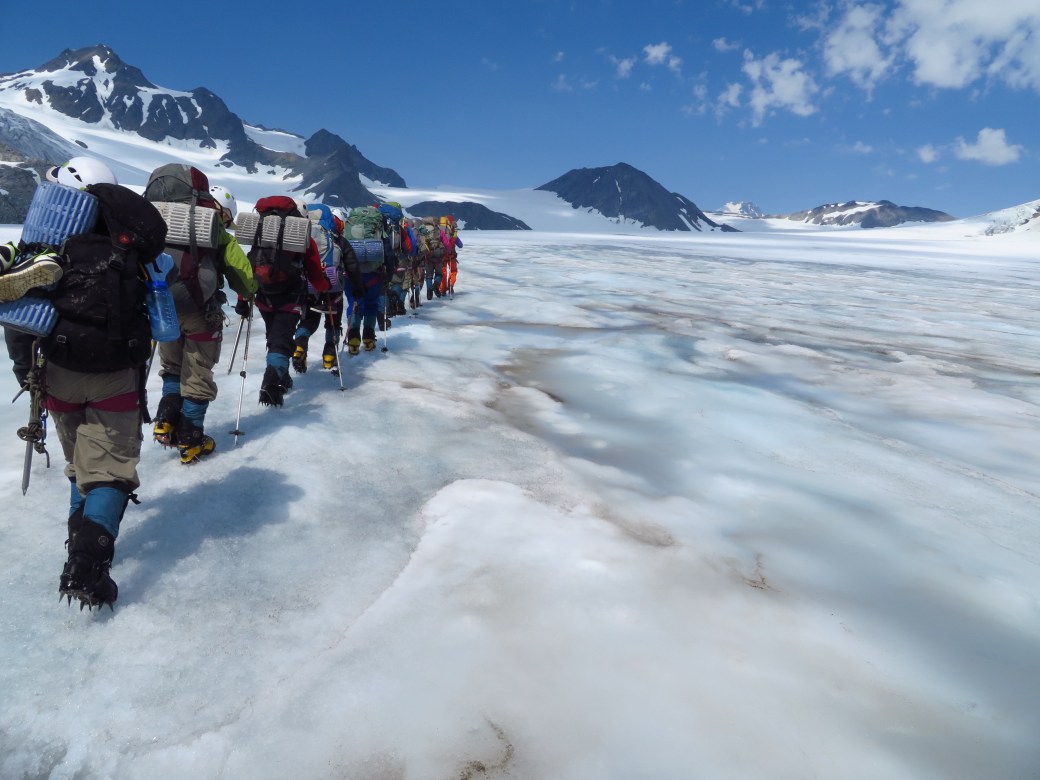
Later in the show we’ll hear from my friend and snow scientist Matthew Sturm on the Norwegian explorer Nansen, but when Matthew was picking his crew for a 2,500-mile snowmachine expedition across arctic Alaska and Canada one of his first choices was Daniel Solie. Daniel is not only a scientist who has designed a physics course for Alaska villagers that draws on their experience, but he is also an accomplished mountaineer. Dan is the fellow on the left in the photo taken during the excursion. As you’ll hear my discussion with him, Daniel also had covered some of the same territory when he was a younger man.

Brian Rogers: Multifaceted Leader

Brian Rogers has been UAF's chancellor since 2009.

This past summer, as part of the centennial celebration of the University of Alaska and UAF, Summer Sessions invited five former leaders of the school to return and reflect on their time with the institution. Brian Rogers story offers a unique perspective. Not only was he a student at the university, as a legislator he oversaw the subcommittee that dealt with the school’s budget. Later, he would serve statewide as Director of Budget Development and Vice-President for Finance. When he started his own company, Governor Tony Knowles appointed him to the UA Board of Regents and following that service he was tapped to become the chancellor of UAF. So, as you can hear, by any measure his experiences with the school is almost unparalleled. It turned out Brian’s experience with higher education had deep roots.

Marshall Lind: History Making Educator

Lind

For over three months this summer I visited with some of the leaders who made their mark on the University of Alaska and UAF. The discussions were prompted by the school’s centennial celebrations.  Marshall Lind served as chancellor at UAF from 1999 to 2005, but before that he served 12 years helming University of Alaska Southeast. While those responsibilities were notable, it was his service as Alaska’s Education commissioner that proved to be historic.

In 1971, Lind was appointed commissioner of the Alaska Department of Education, a post he retained until1983. During that tenure, he helped create the Regional Educational Attendance Areas and implemented the so-called Molly Hootch Consent decree, that transformed how the state would provide education in rural Alaska.

Lind received the 2002 Denali Award from the Alaska Federation of Natives, the highest honor AFN gives to non-Natives, for his commitment to serving the educational needs of rural and Native Alaskans.

The audio for this podcast was drawn from the video taken at the live event and there were some microphone level issues during the recording. I began my conversation with Lind looking at 1961, the year he and his wife Lois began teaching with the Bureau of Indian Affairs in the Yukon-Kuskokwim Delta.

Wendy Redman: UA’s Wonder Woman


redman

I first met Wendy Redman in the spring of 1983. I was new to Fairbanks and all I knew was that she worked for the University of Alaska Fairbanks in some capacity. One evening, at a party, I found myself paired with a guy named Pat O’Rourke in a game of pinochle. Wendy was paired with Pat’s wife Charla. When I asked Pat if he taught at the school, he said he worked in administration with Wendy. It’s a good thing. I don’t think I could have played that game knowing I was sitting down with the University of Alaska Fairbanks’ chancellor and chief lobbyist.

I tell that story to give you a sense of the self-effacing character of Wendy and Pat. As you will hear the two worked together to form the state’s community college system and when Pat became chancellor he tapped Wendy to represent the school in Juneau. But Wendy’s link to the University began far earlier.  She arrived in Alaska more than 45 years ago. Her almost forty-year career with the school began in 1972 in the Biology Department, becoming the school’s first Administrative Assistant. She eventually rose to become executive vice president for university relations. In 1998 she was interim UA President for several months between the departure of Dr. Jerome B. Komisar and General Mark Hamilton’s first day on the job.

Wendy, helped form the Alaska Women’s Commission and created the Women’s Center at UAF. She’s received several honors. In 2000, she was awarded the Edith R. Bullock Prize for Excellence, and in 2010 was recognized as a woman of distinction by the local Girl Scouts.
Wendy was born and raised in Eastern Washington, near Lake Chelan. She attended Eastern Washington University and the University of Washington, eventually receiving her masters of public policy degree from the Kennedy School of Government at Harvard University in 1984.

When she retired, Wendy returned to Chelan and I began our discussion by asking about her childhood and why she returned to her hometown.

Dana Thomas: An Academic for All Seasons

DanaThomas

When University of Alaska Fairbanks Chancellor Brian Rogers departed in 2015, the position went through a series of interim leaders. In part, state-wide administrators were examining whether a chancellor was needed and if a single accreditation plan for the system over individual campuses was efficient. During that process one of the leaders who came forward to helm UAF was Dana Thomas. Born and raised in Fairbanks, Thomas attended UAF as a student. Following his graduate studies he returned as a professor of statistics. He also filled many key leadership roles, initially retiring as statewide Vice-president of academic affairs and research. This breadth of experience and longevity with the school made him an ideal choice for Summer Sessions salute to the University of Alaska’s centennial celebration this summer. My thanks to Michelle Bartlett of Summer Sessions for inviting me to host the series of live talks with guests and allowing Northern Soundings to air the discussions.